Kelynto is an enterprise planning intelligence platform for retail planning organizations.
Your Monday business review, already explained.
Kelynto explains why last week's sales differed from plan, store by store, with the evidence behind every cause. It works alongside the planning system you already run and replaces none of it.
The sample workspace is not open to visitors yet. The tour uses real screens from it.
Opens a private sample workspace with a synthetic retailer. No conversation needed first.
Why it exists
Every Monday, someone has to explain last week.
Which stores missed plan, which beat it, and why. The planning system supplies the numbers. The explanation is still put together by hand, from spreadsheets, store calls and memory.
Today
"Why did Produce miss plan in the Valley stores?"
- The week closes. Actuals land. The misses show up in the dashboard.
- The calls start. Stores and distribution centers. Was it a stockout, the weather, a promotion across the street?
- Sunday night. Spreadsheets, dashboards, emails and chat threads become a narrative.
- Monday. Leadership asks a question the deck does not answer.
With Kelynto
A first draft is waiting on Monday morning.
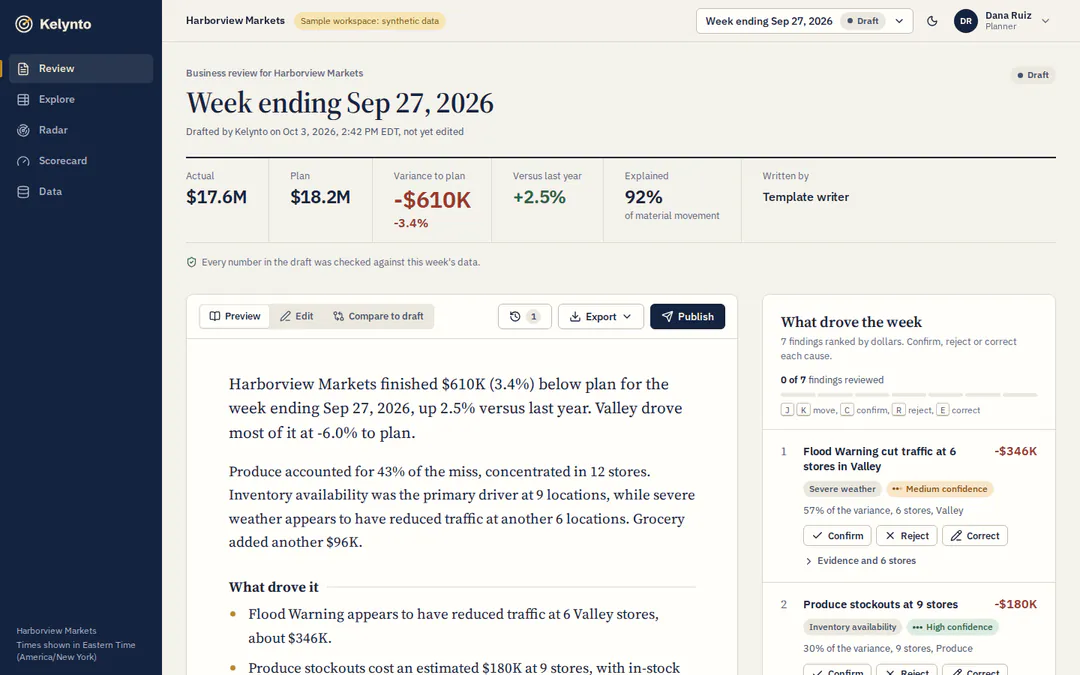
Produce accounted for 43% of the miss, concentrated in 12 stores. Inventory availability was the primary driver at 9 locations, while severe weather appears to have reduced traffic at another 6 locations.
That paragraph is from the sample workspace, on synthetic data. Each cause arrives with its stores and its evidence. Your planner checks it, corrects what they know better, and sends it up.
- Who uses it Demand planners, merchandise planners and analysts: the people who write the weekly commentary.
- Who reads it Directors and vice presidents in planning, merchandising, supply chain and store operations.
- Where it fits Retailers with a plan by store and category and a review owed every week. The design centre is roughly 50 to 500 locations.
Why your planning system does not make it redundant
Your planning system makes the plan. Kelynto explains the variance to it.
They do different jobs, and Kelynto needs the first one to exist. It reads the plan you already have and never changes it.
Planning system
What should happen
Forecasts, replenishment and the plan. Kelynto does none of this.
Dashboards
What happened, and where
Variance by region, category and store. The cause is left for a person to find.
Kelynto
Why it happened
Each cause with its stores and evidence, written up as a draft, checked by your planner, and kept on record.
A simple test. Does a planner on your team still spend part of Monday working out why stores missed plan, then writing a paragraph for leadership? If yes, that is the work Kelynto covers. If your current system already gives leadership the why, you do not need this, and we would rather you found that out here.
What it is not: a forecasting platform, a BI tool, a chatbot or a supply-chain suite. It takes a weekly file from whatever you plan in, including a spreadsheet. There is no built-in connector to any planning product today.
One loop, every week.
Explain, Watch, Act, Score. The last step tells you whether the first three are worth your planners' time.
-
Explain
What happened last week and why, with evidence.
What it cannot explain, it reports as unexplained.
-
Watch
What is coming near your stores, and which way it should push sales.
Direction only. No sales figure is forecast.
-
Act
Planners confirm, reject or correct each cause and record what they did about it.
Nothing is published until a person publishes it.
-
Score
A scorecard shows whether the explanations and signals are proving useful.
Built from what planners did. Sample sizes shown.
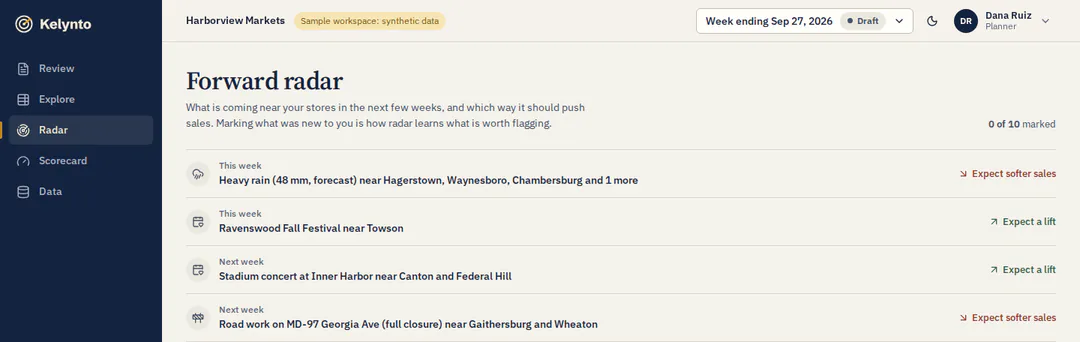
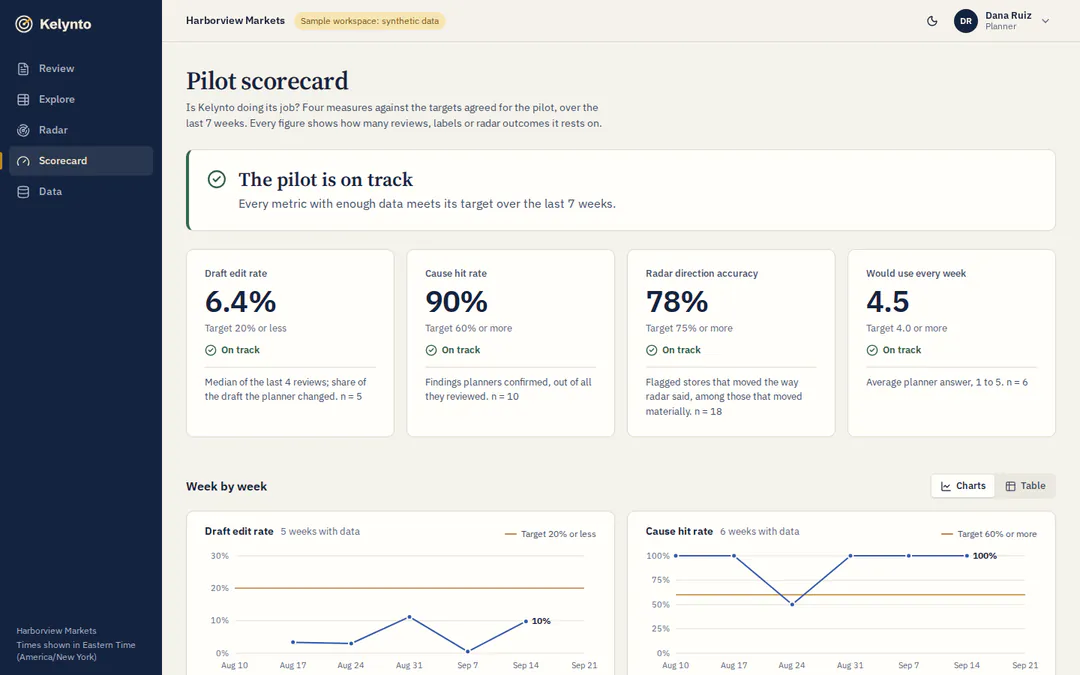
See each part on real product screens, or follow one week from the closed file to the published review.
Why trust it
Built to be checked, not believed.
We have no customer results to show you yet. What we can show is how every claim in a draft is earned.
- Causes come from rules, not a language model. A cause is credited only when its evidence clears a statistical bar. Read the methodology.
- Unexplained stays unexplained. Nothing is forced onto a weak cause.
- Every number is checked. A draft with a figure that does not trace to your data is discarded before a planner sees it.
- Your planner decides. Each cause is a candidate until a person confirms, rejects or corrects it.
- We say what is missing. No customers, no SOC 2 report, no penetration test and no benchmark results yet.
Open the Trust center, where every control carries its real status.
For your architect
Fits the environment you already run.
The questions an enterprise architect asks first have plain answers.
- In your own cloud account, or managed by us. The same software either way. Neither is running on live infrastructure yet.
- Weekly totals only. No transactions, shopper, payment or item-level data required.
- Your sign-in. OpenID Connect through your identity provider, four roles, no passwords stored.
- Files in, nothing installed. CSV or Excel, or a scheduled export to an upload endpoint. No agent on your side.
- Tenants kept apart twice. In the application and again in the database.
Read the deployment notes, including what has not been proven yet.
Questions about Kelynto? Ask us.
Ask in your own words, or pick a question. Every answer carries a label: available today, available through enterprise implementation, planned, or not available.
What does Kelynto do?
Kelynto drafts the Monday business review for a retail planning team. Each week it takes sales against plan by store and category, plus in-stock, promotions and local signals, works out where the variance came from, and drafts the commentary with the evidence behind each cause. The planner edits the draft, confirms or corrects each cause, and publishes. It also shows what is coming near your stores in the next few weeks, and keeps a scorecard of whether its explanations are proving useful. It sits above the planning system you already use and replaces none of it. Honest status: it is built and tested locally on synthetic data, and no retailer has run it yet. The quickest way to judge it is a 20-minute conversation about your own Monday review.
How is it different from a planning suite?
They do different jobs. A planning system produces the plan and the forecast, and often the orders that follow. Kelynto starts where that ends: it takes the plan you already have, compares last week's actual sales with it by store and category, and explains the variance with evidence, including causes that sit outside a planning system such as a storm, road work, a local event or a competitor opening. Then it records what your planner confirmed or corrected. It produces no forecast and no plan, and it writes nothing back. You keep your planning system. Kelynto works from weekly files exported from it, so it sits above whichever system, or spreadsheet, produces your plan.
Does it replace our planning system?
No. Kelynto replaces nothing. It does not forecast, plan, replenish or order, and it does not write back to any system. Your planning system keeps producing the plan; Kelynto reads a weekly export of sales against that plan and explains the variance. Nothing is migrated and nothing in your current process is switched off, so if it does not help, you stop and nothing has changed. The only thing it aims to take over is the manual work of finding out why a store or category missed plan and writing that up for leadership, and even there a planner still edits and publishes every review.
Can it work with SAP?
It works alongside SAP, and there is no SAP connector. No integration with SAP IBP, S/4HANA, BW or any other SAP product has been built, and Kelynto holds no SAP certification of any kind. What it needs is a weekly export of sales against plan by store and category, a store list, and optionally in-stock and promotions. Any system that can produce those files can feed it. The usual pattern is a scheduled job on your side that writes the files and posts them to the upload API using a token from your identity provider. Setting that export up is implementation work done with your data contact, not a product feature. A first evaluation can start with files exported by hand.
Can it run in our Azure environment?
Available through enterprise implementation. The deployment kit for Azure is built and validated statically; it has not yet been deployed to a live subscription. What the kit is: Bicep templates for a single-tenant install in your own subscription (Container Apps for the API, web app and scheduler, PostgreSQL Flexible Server on a private network, Key Vault, Log Analytics, optional Front Door), signing in with your own directory, plus scripts for preflight, deploy, validation, upgrade, rollback and uninstall. A private shape adds your existing virtual network, private endpoints, internal ingress and a database key you hold. The templates compile and lint, the scripts ran against stand-ins, and the same container stack ran locally in production mode with a full onboarding rehearsal. The first real deployment would be the validation run, so small fixes should be expected. You own the subscription, network, keys and backups.
What data does a pilot require?
Four things. A store list with store code and region, and coordinates for all or nearly all stores. Weekly sales and plan by store and category: 26 weeks or more of history, then the closed week every week. In-stock by store, week and category if you have it, at least nine weeks, or an acceptance that stockouts will not be attributed. Optionally promotions and local signals you know about. We also ask for four to eight weeks of the commentary your team already wrote, for the backtest, and for two facts before the first load: the day your fiscal week starts and the time zone most stores are in. CSV or Excel, your own column names. Aggregates only: no transaction, shopper, payment or employee data.
How long does implementation take?
Planning estimates, stated as such: no customer has gone through it yet. From a signed pilot to the first scheduled Monday review is about two weeks when registering the application in your identity provider takes a week. It can be as little as three or four working days on the shared sign-in provider with clean files. The step that usually sets the pace is your own change process for registering an application, which we do not control; the first data export is estimated at two to seven days. The pilot itself then runs about six weeks of live reviews. Nothing requires your planner to sign in on day one: if sign-in is the last thing outstanding, the weeks can be run and the commentary sent by email meanwhile.
How is our data protected?
The short version, with its limits. Sign-in goes through your own identity provider, so passwords and multi-factor authentication stay with you; Kelynto stores no passwords. Each customer's data is separated twice, in the application and again in the database with row-level security that shows a connection carrying no workspace nothing at all. Four roles are checked on every request, and every change is written to an audit log. The product holds weekly sales, plan and in-stock totals by store and category, never shopper, payment or employee data. AI text generation is off by default. Encryption in transit and at rest comes from the platform it is deployed on. There is no SOC 2 report or other attestation, no external penetration test and no hosted service yet; the product is built and tested locally. The Trust page lists every control with its status.
What does a pilot look like?
A pilot answers one question on your own data: would this planning team use Kelynto every Monday? It has two parts. First, a backtest: we load your history, run four to eight past weeks and set each draft beside the commentary your team actually wrote, so you see the fit before anyone changes how they work. Then about six live weeks, in which the review is produced each week and one planner edits it, confirms or corrects each cause, marks radar items and answers two pulse questions. It ends with a readout of four scorecard measures agreed at the start. Honest status: no pilot has been run yet. You would be among the first, and the scorecard is there so the result is measured in the open.
Can we try it before speaking with sales?
Not yet, and we would rather say so than send you to a form. Two self-service routes are built: a one-click sample workspace filled with synthetic data, and creating your own workspace with sign-in by emailed link. Neither is open, because the product is not hosted yet; the site shows those two links only once the product itself reports them as on. What you can do now without a call: take the product tour on the site, which shows real screens of the product with the synthetic demonstration retailer, read the deployment and trust pages, and ask this assistant. To see it working on your own questions, the route today is a 20-minute conversation with the founder, who is the only person you would be talking to; there is no sales team. Book at https://calendly.com/kelynto.
Start from your seat.
Six roles have a say in a decision like this, and each asks different questions. Go straight to yours.
-
Demand planning leader
- What does my planner's Monday look like?
- How does it decide a cause, and can I challenge it?
- How will we know whether it works?
Next: Take the product tour
-
Merchandise planning leader
- Can it tell a promotion from a category-wide shift?
- What does a review by category look like?
- What data do you need from us?
Next: Take the product tour
-
Supply chain executive
-
Operations leader
-
Enterprise architect or IT
-
Procurement or security reviewer
Four ways to take the next step.
-
Explore
See the product
The sample workspace is not open to visitors yet. The product tour shows nine real screens from it.
A private copy of a synthetic retailer, Harborview Markets. No conversation needed first.
-
Evaluate with your data
Run it on your own weeks
A backtest on your past weeks, then about six live Monday reviews, judged on four measures agreed before it starts.
Create a workspace and load your own files. Sign in by an emailed link. No password to create.
-
Deploy in your environment
Check the architecture
What runs where, what crosses the boundary, and how far each path has been proven. Azure first.
-
Talk to us
Twenty minutes with the founder
Your process and your questions. Or write to marc@kelynto.com.
Kelynto is an early-stage company opening its first pilots with retail planning teams. The product is built and tested on synthetic data. There are no customers and no results yet, and this site says so wherever it matters.