For planning and open-to-buy services, retail software vendors and consultancies.
Give every client a written weekly review, inside your product and under your brand.
Kelynto is an explanation layer on top of your planning service or product. Your system holds each client's sales and plan. Kelynto turns them into the weekly review: what the client's own records explain, with the evidence behind it, what is on file near their stores, what is still open, and what is coming against plan. Your clients read it in your screens, and in documents and email that carry your name.
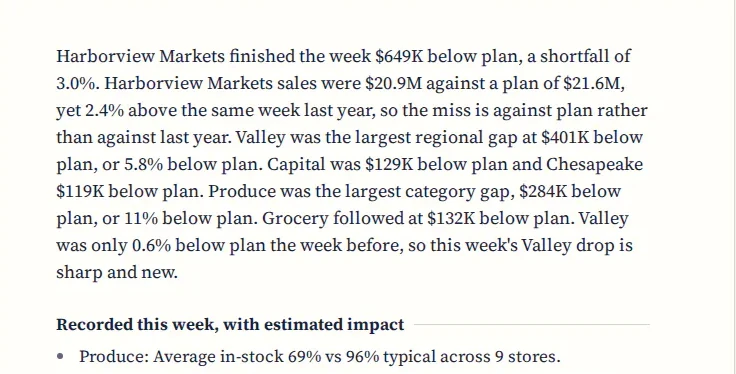
From the data you already hold to a review your client reads.
Your system
One export for all your clients, or one API call per client: weekly sales and plan by store and category, and in-stock, promotions and receipts where you hold them.
Kelynto
One workspace per client. Every file is validated and reconciled to its control totals. The engine computes the week, and the review is written from its figures.
Your clients
The review, the Outlook and the documents: framed in your application, sent under your name, or opened in Kelynto by the client's own people.
What changes in your business
The same engine, a different gain for each kind of firm.
-
Planning and open-to-buy services
Every client's week explained before your advisor opens the file.
One ranked page across all your clients, and for each client a write-up you can send under your name, from the export you already produce.
-
Retail software vendors
A written plan-against-actual review inside your product.
Your multi-store customers read why the week differed from plan, with every figure traced to their own records, and you build and run no analytics engine.
-
Consultancies and implementers
Leave your client with the weekly review running.
Written from their plan and actuals, checked by their planner, and set up by your team, who stay in the account through the partner console.
What your clients get.
Three things, every week. The screens are the product on a synthetic retailer.
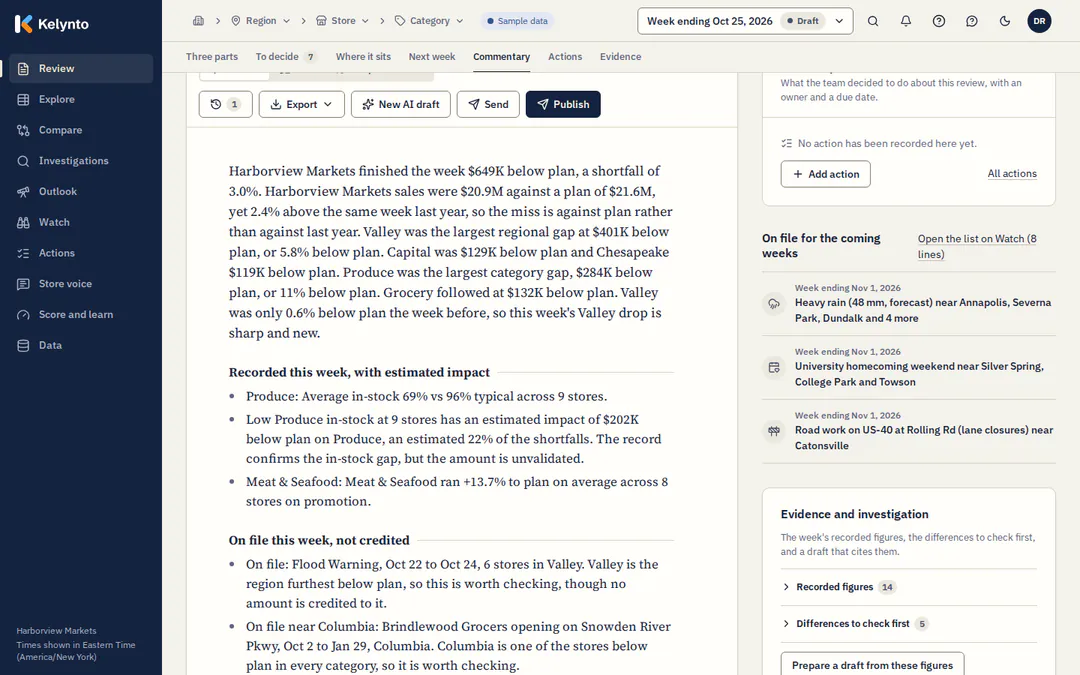
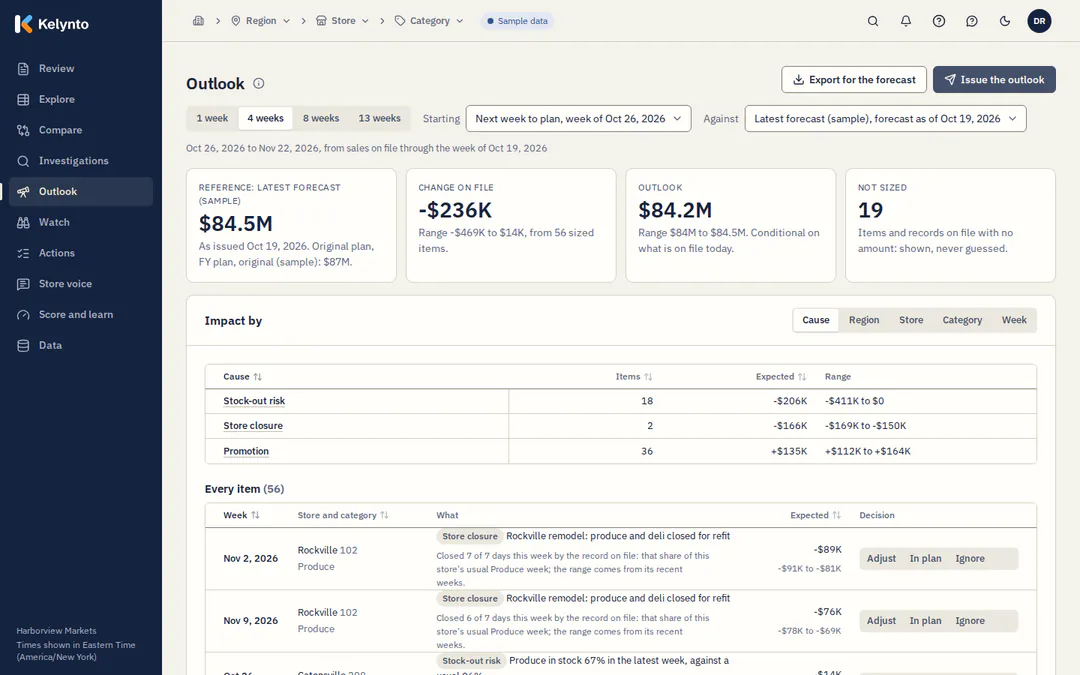
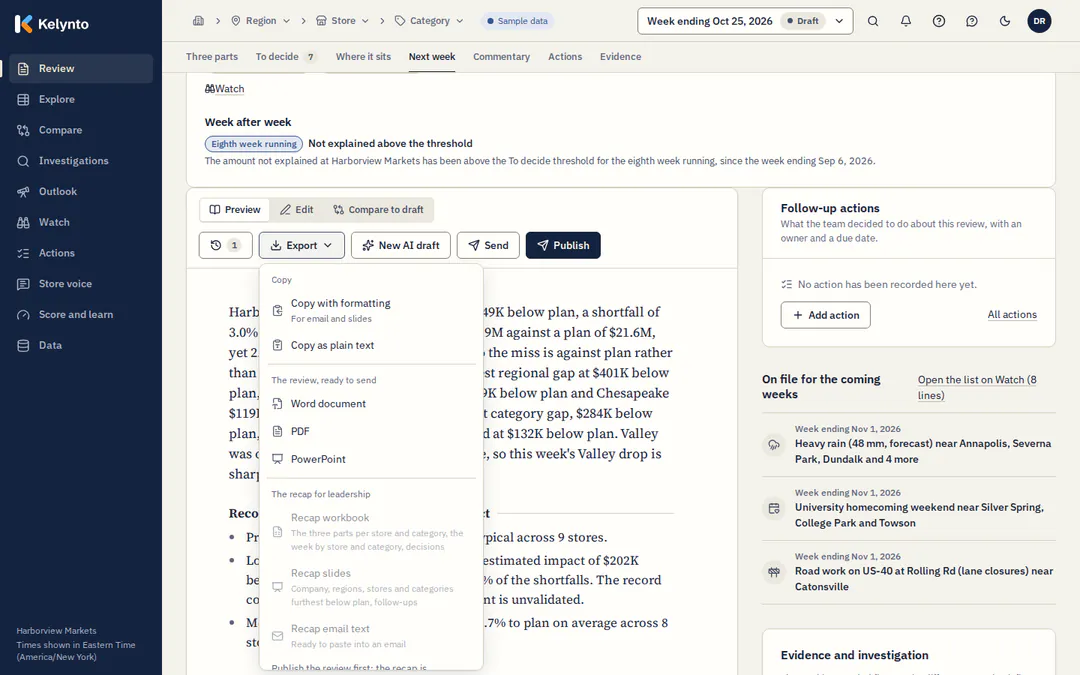
Three ways to deliver it.
Use one, or all three for the same client.
- Embedded. Show a client's review, Outlook, causes and This quarter inside your own application. Your server asks for a single-use link for one person and one client, and your page frames it. No Kelynto account and no second sign-in for your people.
- Through the API. Create a client, send its files, produce and read its review, download the documents, and be told by signed webhook when something happens.
- As Kelynto. Each client workspace is also a standalone Kelynto workspace that the client's own people can open.
The developer overview, with the quickstart, the embedding guide and every route.
Built for a book of clients.
What a firm with many clients needs on day one.
- One workspace per client. Every call names one client and is bound to that one workspace. A client that is not yours answers not found.
- Your brand. Your name, logo and color on the embedded views, the documents and the email your clients receive.
- Your people, your directory. Your team signs in through your own identity provider and reaches your clients only.
- Licenses as a pool. A wholesale agreement gives you a pool of client licenses, allocated when you add a client and returned when one leaves.
- A console for your team. Your clients side by side, each line what that client's latest review states, with your keys, webhooks, usage and your own log.
- Measured at 200 clients. On a 2-core machine with synthetic data, 200 client workspaces (492 stores, 91,440 rows) were imported in about three and a half minutes, and their weekly reviews ran in about 32 seconds, four at a time.
Works with what your clients already run.
Kelynto works from files. It reads the standard exports of these systems as they are, and maps every column on the first upload.
- Lightspeed Retail (R-Series and X-Series)
- Square for Retail
- Shopify POS
- NCR Counterpoint
- Retail Pro
- Microsoft Dynamics 365 Business Central
- Clover and RICS, with a ready mapping
- An open-to-buy plan by month and class
- A weekly recap workbook
Your own export can carry many clients in one file. Each client is loaded into its own workspace, and each must reconcile to its control totals before anything loads. The names above are trademarks of their owners; Kelynto reads the files these systems export.
The client relationship stays where it belongs.
- One channel per client Every client workspace records its channel: you, or Kelynto directly. Your clients are yours on the record.
- The client's data is the client's Its data and its reviews belong to the client, and each client's consent is recorded before its data loads.
- Publishing is the client's choice Your key publishes to a client's readers only when that client's admin has allowed it.
- Everything is on the client's record Every request made for a client is in that client's audit log, with your key or your person named.
- The AI writer follows your agreement Claude writes a client's review only where the workspace's admin has switched it on, or under your recorded agreement with your clients.
- A client can move A client can leave for Kelynto directly or another partner with its data in place, and the former partner's access ends at that moment.
How tenants and partners' clients are kept apart, control by control.
Four ways to work with Kelynto.
Choose by who sells and who supports. Terms are agreed with each partner.
-
Refer
Introduce the retailers who ask you. Kelynto serves them directly.
-
Resell
You hold the relationship and the contract. Kelynto runs the service for your clients.
-
Embed
Kelynto inside your own product, in your brand, through the API and embedded views.
-
Implement
You set up and run Kelynto for the retailers you advise, alongside their planning system.
Where it runs. Kelynto Managed runs on Microsoft Azure in Central US. Partner sandboxes and client workspaces are opened with each agreement.
Start with a sandbox.
Two synthetic client workspaces and a key that reaches only them. Send a file, produce a review, publish it, download the deck, and frame it in a page of your own. Then run it on the history of a few clients who agree, with your own advisor as the judge.
- Proof on real history. Every figure reconciles to the client's own totals, and each recorded cause opens to the client's own record.
- Your developer's first day. A quickstart in curl and Python, an embedding guide, every route and error code, and a Postman collection.
- Security review ready. Every control with its status and evidence in the Trust center, and a written review pack on request.
Talk to Kelynto about your clients
- Tell us who your clients are and what holds their sales and plan
- See the partner console and an embedded review on synthetic clients
- Leave with sandbox access and the way to a first client
Or write to marc@kelynto.com, or request sandbox access.